Origin of Kenpo Karate
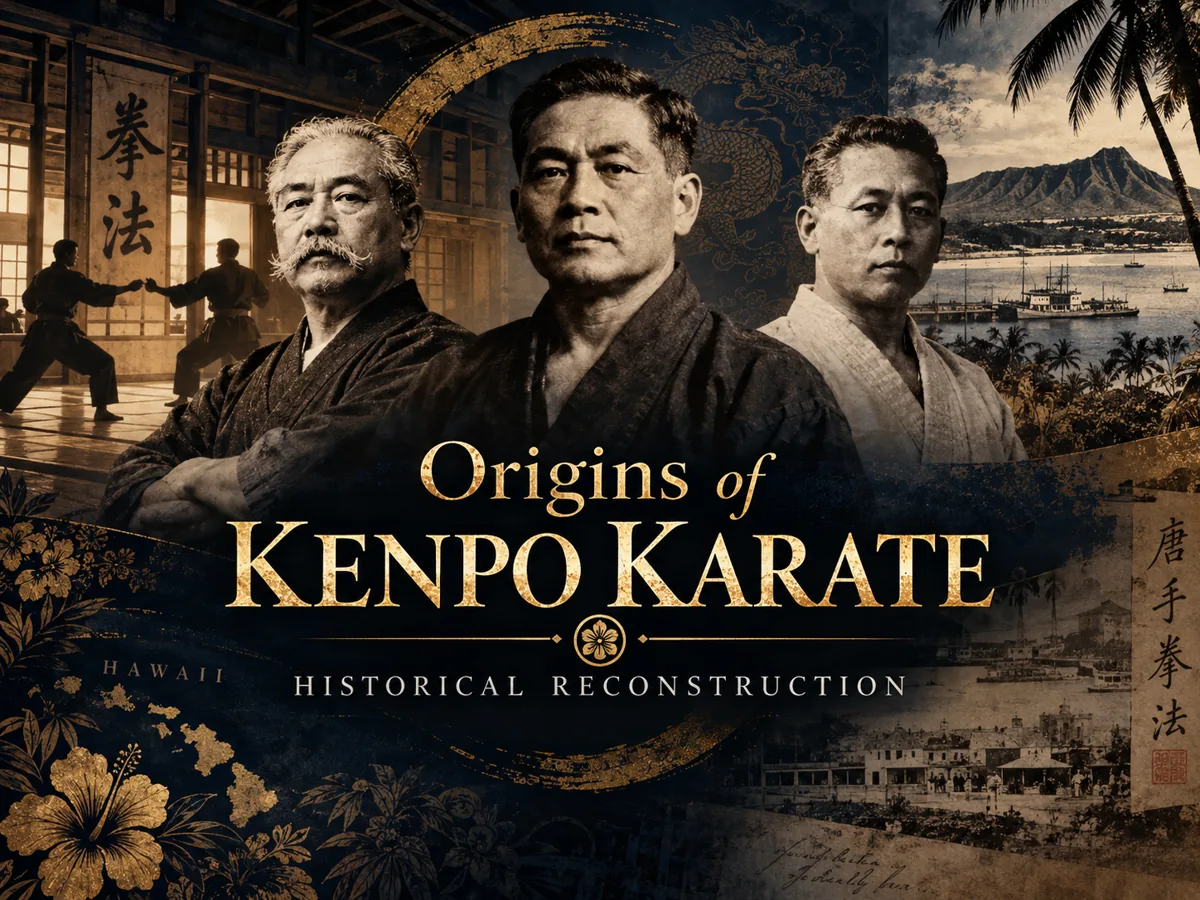
Kenpo in the United States did not emerge from a single moment. It developed through a chain of teachers, changing terminology, Hawaiian martial culture and the rapid expansion of commercial schools on the mainland.
A lineage told through Hawaii
The Tracy historical tradition places James Mitose and William K. S. Chow at the beginning of the lineage that later reached Ed Parker and the Tracy brothers. The precise pre-Hawaiian history is debated, and this reconstruction does not treat every lineage claim as settled fact. What is clear is that Hawaii became the critical meeting ground where Japanese, Okinawan, Chinese, Filipino and Western fighting traditions interacted.
Chow became one of the most influential teachers in that environment. Tracy-family sources describe him using the name Kenpo Karate by the late 1940s. The name itself signaled a practical synthesis: Kenpo—often rendered as ‘fist law’—combined with the increasingly familiar word karate.
From Parker to the mainland
Ed Parker carried the art into a mainland American setting. His teaching at Brigham Young University and later his Pasadena school put Kenpo in front of students who had previously known little beyond judo, boxing and the first wave of Japanese karate. Parker’s talent was not merely technical; he was a communicator who presented the art in the language of American self-defense.
The Tracy brothers entered Parker’s school during this formative period. Their later contribution was organization: cataloging, naming, sequencing and teaching large numbers of self-defense techniques through a repeatable lesson structure.
Why the history remains contested
Kenpo history contains strong personalities and competing institutional memories. Later systems often describe the same events differently. The purpose of this site is therefore not to flatten every disagreement into one official story. Where an assertion comes specifically from Tracy-family material, it is identified as the Tracy account. Documentary evidence, certificates, dated photographs and period publications are given greater weight whenever they survive.
Sources & editorial notes
These sources help document the historical reconstruction. Some are lineage-specific accounts and should be read as such.